The Greatest No-Hitters in Baseball History
A no-hitter is the rarest sustained excellence in baseball — nine innings of dominance, one mistake away from history. These are the ones that earned their place in the permanent record.
On July 8, 2026, Dylan Cease took a no-hitter into the ninth inning at Rogers Centre — 11 strikeouts, three walks, and the growing electricity of a crowd watching a pitcher flirt with something rare. Kazuma Okamoto's single ended it. Baseball exhaled, noted it, and moved on. But for eight innings, everyone watching was holding the same breath that generations of fans have held watching the game's most impossible standard: no hits allowed, no exceptions.
The no-hitter is the most unforgiving stat in baseball. A perfect game allows nothing — no walks, no hit batsmen, no errors. A no-hitter allows a baserunner by any means necessary but not a single hit. Both require the concentration of an entire team behind a pitcher for a minimum of 27 consecutive batters without the ball falling fair. There have been 326 no-hitters in major league history. There have been 24 perfect games. In any given season, the odds of witnessing one are low enough that fans who see a complete no-hitter in person remember it forever.
These are the greatest ones.
1. Johnny Vander Meer's Back-to-Back (1938)
The one that still can't be explained
On June 11, 1938, Johnny Vander Meer of the Cincinnati Reds no-hit the Boston Braves at Crosley Field. A complete game, nine innings, zero hits. Impressive. Historic. Then, four days later — June 15, 1938 — Johnny Vander Meer no-hit the Brooklyn Dodgers at Ebbets Field.
Back-to-back no-hitters. No one has ever done it before. No one has done it since. In 88 years of baseball after that night, with thousands of pitchers throwing tens of thousands of games, no one has matched it. It is the most singular achievement in a sport full of them.
The second no-hitter — the one against Brooklyn — came on the first night game ever played at Ebbets Field, in front of 38,748 fans who had come for the occasion of lights baseball and instead witnessed something that still sits alone in the record book. Vander Meer walked eight batters; the Reds won 6–0. The walk total would normally make it feel like a labored performance, but no Dodger hitter ever came close to a hit. When Leo Durocher grounded out to end the ninth, the record was set. It will never be broken. It can only be tied.
The scorecard from June 15, 1938, shows what back-to-back no-hitters look like from Brooklyn's side: eight walks spread across nine innings, zero hits in the box score, and a final line that has never been matched.
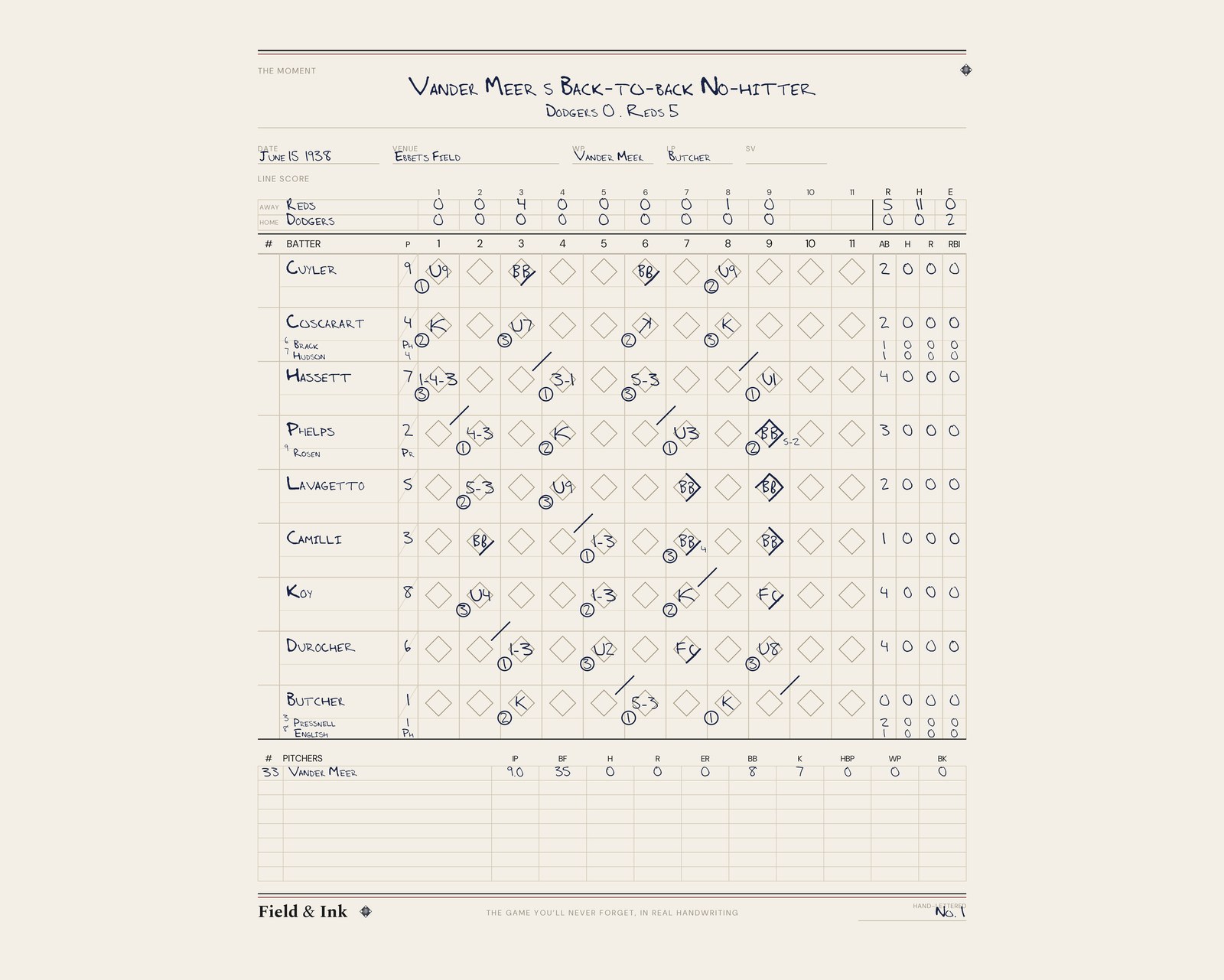
Vander Meer's 2nd No-Hitter — June 15, 1938
The second of the only back-to-back no-hitters in MLB history. Ebbets Field. The first night game. A record that has never been touched.
Get this scorecard — $29 →2. Randy Johnson's Perfect Game (2004)
Twenty-seven up, twenty-seven down — at 40 years old
Randy Johnson was 40 years old on May 18, 2004. He had already thrown 4,000+ career strikeouts, won five Cy Young Awards, and pitched one of the most devastating individual seasons in baseball history in 2001. Then he faced the Atlanta Braves in Phoenix and retired all 27 batters he faced.
A perfect game. At 40. The Unit — 6'10" of pure left-handed menace — threw 117 pitches, struck out 13, and never allowed a Braves hitter to reach base. He is the oldest pitcher ever to throw a perfect game by several years. Bob Gibson, Sandy Koufax, Jim Bunning — the greats who dominated their eras were doing it in their late 20s and early 30s. Johnson did it in his fifth decade.
The Atlanta Braves that day were not a powerless lineup. Chipper Jones, J.D. Drew, and Andrew Jones were in the batting order. Johnson faced them and every other Atlanta batter twice, and not one reached base. The final out — a fly ball to center — ended at 10:36 PM Mountain Time. The box score showed 27 batters faced, 27 batters retired, zero hits, zero walks, zero baserunners.
The scorecard shows what that looks like from Atlanta's side: nothing but outs, inning after inning, the cleanest kind of perfection the game allows.
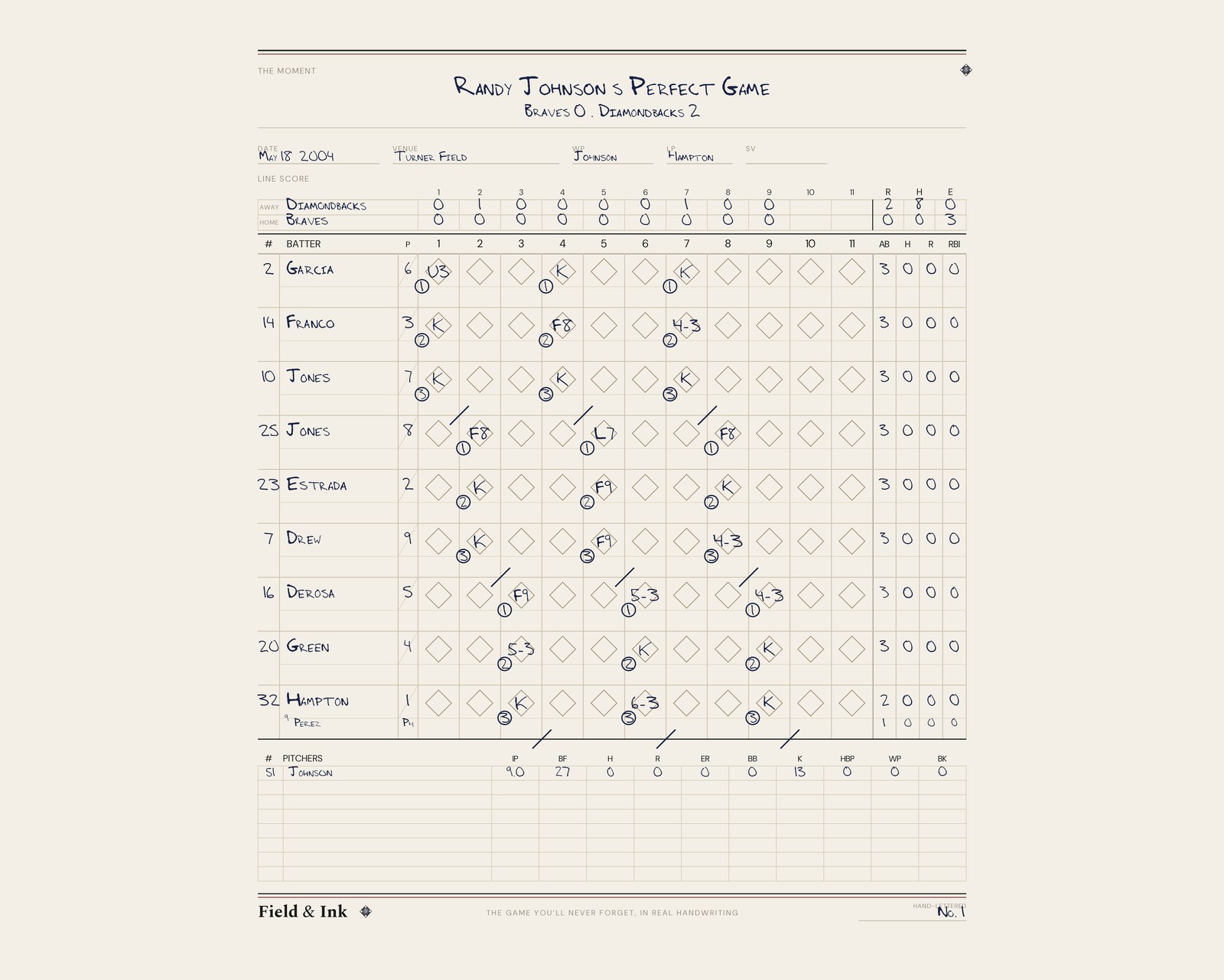
Randy Johnson's Perfect Game — May 18, 2004
The oldest pitcher ever to throw a perfect game: 40 years old, 27 up and 27 down, shown from the Braves' side. 13 strikeouts. Not one Atlanta batter reached base.
Get this scorecard — $29 →3. Johan Santana's No-Hitter for the Mets (2012)
The one New York had waited 51 years for
The New York Mets entered the 2012 season as the only one of the original 1962 expansion franchises that had never had a no-hitter. Fifty years of baseball. Seaver, Koosman, Gooden, Cone — all the great arms had come close, but none had finished what they started.
Johan Santana was recovering from shoulder surgery. He had thrown 134 pitches through eight innings in his previous start. He was pitching on a short rest in St. Louis, and the Mets' coaching staff was nervous about his arm. On June 1, 2012, at Citi Field against the Cardinals, Santana threw 134 pitches, struck out eight, walked five, and no-hit St. Louis for nine innings.
The Mets won 8–0. The crowd in Queens — a knowledgeable baseball crowd with 51 years of context — understood what they were watching as it happened, and when Carlos Beltran grounded out to end the ninth inning, the noise was something Citi Field has never quite replicated. Santana's shoulder was never the same after that outing; he made only 10 more starts in his career. Whether the no-hitter was worth it is a question only Santana can answer. But that night, June 1, 2012, it happened.
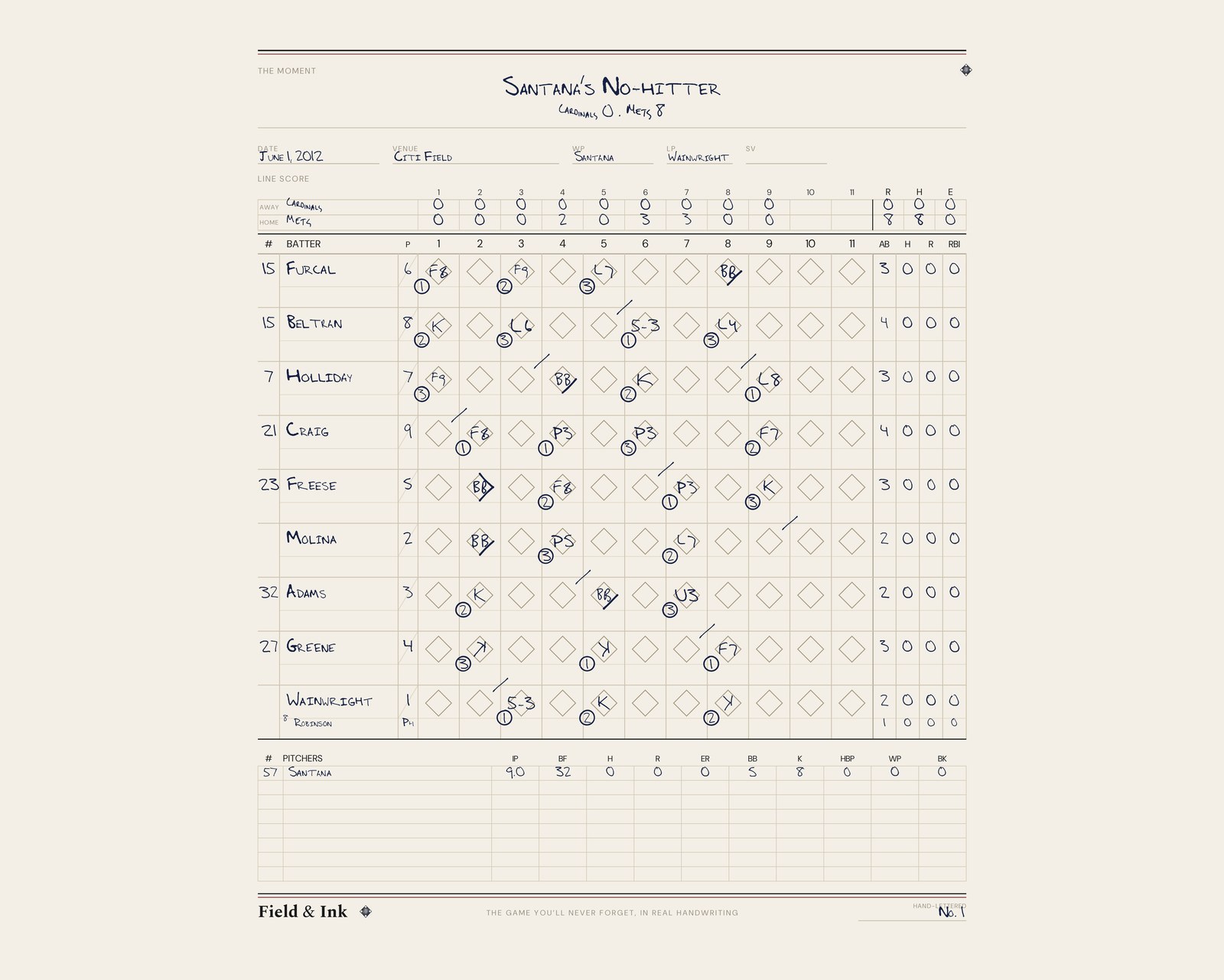
Santana's No-Hitter — June 1, 2012
The first no-hitter in Mets history, 51 years in the making. Johan Santana, 134 pitches, eight strikeouts. The night Queens finally got the no-hitter New York had been waiting for.
Get this scorecard — $29 →4. Nolan Ryan — Seven Times
The record that makes every other no-hitter look like a single event
Nolan Ryan threw seven no-hitters over his 27-year career. Seven. The next most in baseball history is four, by Sandy Koufax — and Koufax was finished pitching at 30. Ryan threw his seventh no-hitter at age 44, in May 1991, against the Toronto Blue Jays, becoming the oldest pitcher to no-hit a team. The record of seven no-hitters is not in the same category as other records that might someday fall. Nobody is going to throw five, then six, then seven no-hitters in their career. The record stands alone, the way .406 stands alone.
Ryan's seven no-hitters stretched across three franchises — the Mets, the Angels, the Astros, and the Rangers. His first came in 1973 when he was the hardest thrower in the American League. His last came in 1991 when he was, by most estimates, still throwing 96 miles per hour. The consistency of excellence across two decades is the part that defies understanding.
5. Don Larsen's Perfect Game, 1956 World Series
The only perfect game in postseason history
On October 8, 1956, Don Larsen of the New York Yankees threw the only perfect game in World Series history — the only perfect game in postseason history, before or since. He faced 27 Brooklyn Dodgers batters and retired all 27. Mickey Mantle made a remarkable catch in center field. Yogi Berra leapt into Larsen's arms at the final out. The Dodgers had Jackie Robinson, Duke Snider, Roy Campanella, Pee Wee Reese, and Gil Hodges — and none of them could get a hit.
The peculiar footnote: Larsen had been knocked out in the second inning of his previous World Series start. The game before the perfect game, he gave up four runs in 1⅔ innings. The perfect game came without any logical build-up. That October afternoon at Yankee Stadium is the single most improbable starting pitching performance in postseason history — and it hasn't been approached in the 70 years since.
The near-misses that broke hearts
A no-hitter can be broken up with two outs in the ninth by a bloop single. Some of the most significant near-no-hitters in baseball history are their own category:
- Dave Stieb, 1988 (twice): Lost his no-hitter with two outs in the ninth inning — not once but twice within ten days. Stieb eventually threw a no-hitter in 1990.
- Harvey Haddix, 1959: Retired 36 consecutive batters — a perfect game through 12 innings — then allowed the only hit in the 13th and lost both the no-hitter and the game. His performance has never been matched.
- Dylan Cease, July 8, 2026: The Blue Jays right-hander carried a no-hitter into the ninth inning against the Giants, striking out 11, before Kazuma Okamoto singled to end the bid. The Giants lost 10–0. The near-miss was the biggest individual pitching story of the 2026 season so far.
What a no-hitter scorecard shows
In a normal game scorecard, the hits column tells a story: who reached base, when, on what count, off which pitcher. In a no-hitter scorecard, the hits column is empty. Nine innings of batters up and batters down — a wall of zeros in the H column on the pitcher's side, and in the batter's column, nothing but outs.
Looking at the scorecard from Randy Johnson's perfect game, or Vander Meer's 1938 no-hitter, or Santana's 2012 gem, you can see the game unfold pitch by pitch: the at-bat sequences, the strikeouts marked with a K, the groundouts and flyouts that built toward history. The empty spaces where hits would normally appear are, in their way, the most significant marks on the page.
Field & Ink has three no-hitter and perfect-game scorecards in the catalog — Vander Meer's second no-hitter (1938), Randy Johnson's perfect game (2004), and Santana's Mets no-hitter (2012). Each is a $29 digital download, print-ready at 300 DPI. Or use the Game Finder if your no-hitter isn't in the catalog.
Use the Game Finder to order a scorecard from any MLB game →
More baseball history: Greatest Game 7s in baseball history · Greatest extra-inning games · How to keep score in baseball · Greatest MLB All-Star Games in history